








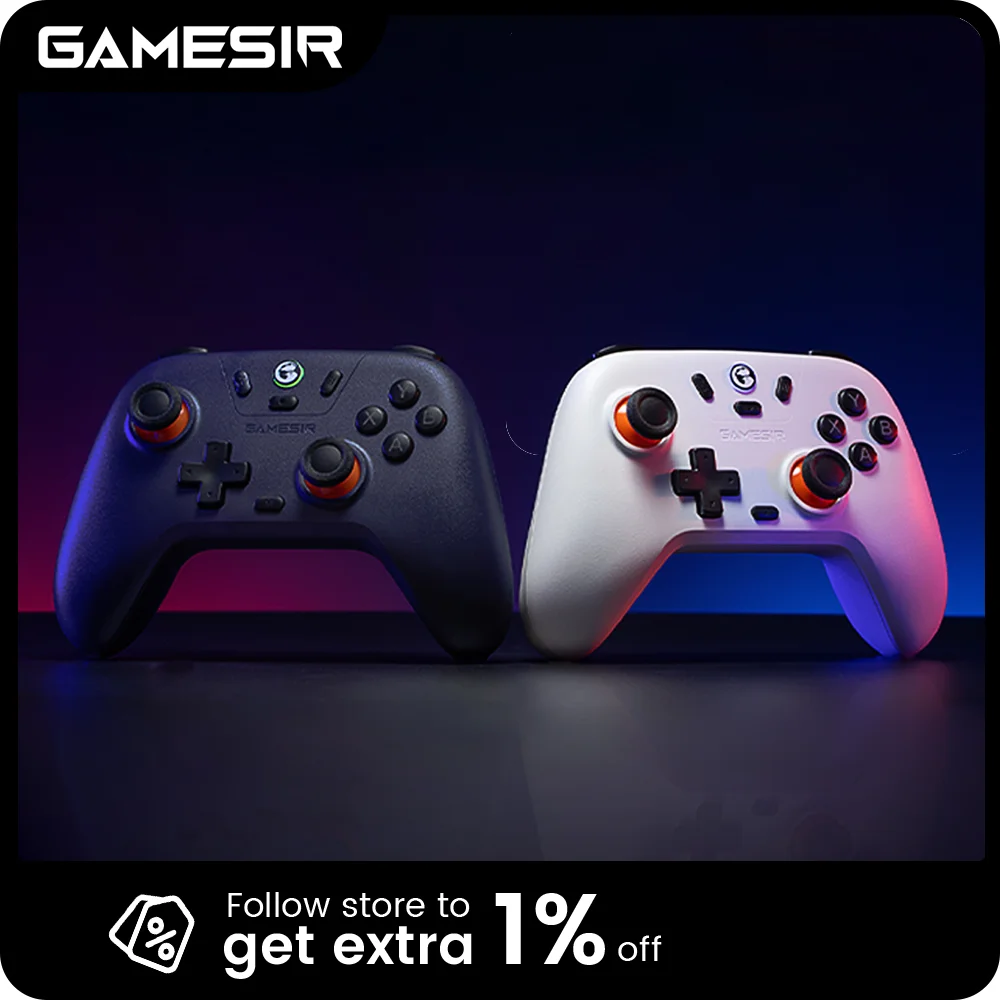
The global gaming controller market is projected to reach $8.5 billion by 2028, growing at a compound annual rate of 7.2%. For small importers, gaming peripherals — especially controllers — represent a high-volume, recurring-revenue category with strong year-round demand and predictable seasonal spikes. Products like the GameSir T4 Nova Lite, with Hall Effect joysticks and multi-platform compatibility, demonstrate exactly what today’s market demands: affordable professional-grade controllers that work across Switch, PC, mobile, and cloud gaming platforms.
Gaming controllers have several advantages over other consumer electronics categories for importers. They are compact (low shipping costs), durable (low return rates of 3-5% for quality units), and consumable (gamers replace controllers every 12-18 months). The margins are healthy — 35-50% gross for standard controllers and 45-60% for premium Hall Effect models. This guide covers everything you need to know about sourcing, importing, and selling gaming controllers profitably.
The Nintendo Switch alone has sold over 140 million units worldwide, and a significant percentage of owners seek alternative controllers for better ergonomics, drift-free joysticks, or multi-platform use. Meanwhile, PC gaming continues growing at 5.2% annually, with platforms like Steam reporting 33 million concurrent users in 2026. Every one of those users is a potential customer for an affordable, high-quality third-party controller. The total addressable market for gaming controllers encompasses over 500 million console gamers, 300 million PC gamers, and 1.5 billion mobile gamers — representing a vast and growing opportunity for well-positioned import products.
Understanding the Gaming Controller Market Landscape
The gaming controller market has evolved significantly over the past five years. Several structural trends are driving demand that importers should understand before sourcing:
Multi-Platform Gaming Is the New Standard
Gamers no longer play exclusively on one platform. The same person might game on a Nintendo Switch during commute, a PC at home, and an iPhone during lunch break. Controllers that work across all these platforms — like the GameSir T4 Nova Lite with Hall Effect joysticks — command higher prices and satisfy broader demand. Multi-platform compatibility is now a baseline expectation, not a differentiator.
Hall Effect Technology Is Disrupting the Category
Traditional analog joysticks use potentiometers that wear out over time, causing the infamous “stick drift” problem that plagues Nintendo Switch Joy-Cons and older Xbox/PlayStation controllers. Hall Effect sensors use magnetic fields instead of physical contact, eliminating stick drift entirely and offering lifespans of 5-10 million cycles versus 500,000 cycles for traditional potentiometers. This technology, once reserved for $150+ premium controllers, is now available in $25-50 controllers from brands like GameSir, GuliKit, and 8BitDo. Importers who source Hall Effect controllers benefit from a clear selling advantage: “drift-free guaranteed.”
Cloud and Mobile Gaming Expansion
Cloud gaming services — Xbox Cloud Gaming, GeForce NOW, Amazon Luna — are growing rapidly, with an estimated 30 million subscribers worldwide by end of 2026. These services require controllers, and most cloud gamers play on devices that need Bluetooth controllers: phones, tablets, smart TVs, and laptops. This creates a secondary demand driver independent of console sales cycles. Mobile gaming controller accessories are the fastest-growing sub-segment, growing at 12% CAGR.

Ai Translator Earbud Device Real Time 2-Way Translations Supporting 150+ Languages For Travelling Learning Shopping Business

TV98 ATV X9 Smart TV Stick Android14 Allwinner H313 OTA 8GB 128GB Support 8K 4K Media Player 4G 5G Wifi6 HDR10 Voice Remote iptv

Smart AI Translation Bluetooth Earphones With LCD Display Noise Reduce New Wireless Digital Long Battery Life Display Headphone
Key Specifications to Look for When Sourcing Gaming Controllers
Whether you’re sourcing a single SKU like the GameSir T4 Nova Lite or building a full product line, these specifications determine product quality and customer satisfaction:
- Joystick type: Hall Effect magnetic sensors are the gold standard. Look for ALPS or Kailh sensor modules in cheaper controllers. Test for dead zones (below 5% is excellent).
- Connectivity: Bluetooth 5.0+ with 2.4GHz wireless dongle option is ideal. Wired USB-C is the backup. Avoid micro-USB at any price point.
- Platform compatibility: The most versatile controllers support Switch, PC (XInput/DirectInput), Android, iOS, and Steam. Verify that Switch Pro Controller mode and XInput mode are both implemented.
- Battery life: Minimum 10 hours for Bluetooth controllers. 15-20 hours is excellent. Internal rechargeable batteries are preferred over AA battery compartments for premium models.
- Button quality: Mechanical microswitches for face buttons (3-5 million click lifespan) vs. rubber dome (500k-1M clicks). Hall Effect triggers with analog input for racing games.
- Software support: Remappable buttons, adjustable trigger sensitivity, and firmware update capability via PC/mobile app.
- Build materials: Textured rubber grips, reinforced USB-C port, metal trigger construction for premium models.
The GameSir T4 Nova Lite checks most of these boxes: Hall Effect joysticks, Bluetooth connectivity, USB-C charging, Switch/PC/Android/iOS compatibility, and an ergonomic design. This makes it a strong baseline product that importers can use to establish their gaming peripheral brand before expanding into higher-margin premium controllers.
Supplier Sourcing Strategy for Gaming Controllers
Gaming controller manufacturing is concentrated in Shenzhen, China, with secondary hubs in Dongguan and Huizhou. The supply chain is mature and competitive, which benefits importers with access to quality products at reasonable prices.
Finding the Right Supplier
Start with Alibaba Verified suppliers. Search terms to use: “Bluetooth game controller Hall Effect,” “Switch Pro controller OEM,” “multi-platform gaming controller,” “Hall Effect joystick gamepad.” Filter for Gold Suppliers with 3+ years in business. Request samples from at least 3 suppliers before committing to any order.
Check whether the supplier is an OEM/ODM manufacturer (preferred) or a trading company. OEM manufacturers typically have lower prices, better quality control, and more flexibility for customization (logo, packaging, firmware). Trading companies add 10-20% margin but offer easier communication and smaller MOQs. For your first order, a trading company can be a lower-risk entry point.
MOQ and Pricing Structure
For standard Bluetooth controllers (no Hall Effect): $6-10 per unit, MOQ 200-500. For Hall Effect controllers: $10-18 per unit, MOQ 100-300. For premium controllers (Hall Effect + mechanical buttons + software): $15-25 per unit, MOQ 200-500. Shipping (sea freight, 500 units): $1-2 per unit. Total landed cost: approximately $10-20 for standard, $15-28 for premium. Retail price: $24.99-39.99 for standard, $39.99-59.99 for premium Hall Effect models.
Certifications and Compliance Requirements
Gaming controllers are electronic devices with wireless connectivity and internal batteries, which means several certifications are required depending on your target market:
- FCC (US): Part 15 for Bluetooth/Wi-Fi. Mandatory for selling on Amazon US. Cost: $3,000-8,000 per model for testing and filing.
- CE/RED (EU): Radio Equipment Directive. Mandatory for Amazon EU. Cost: $2,000-5,000 per model.
- Bluetooth SIG listing: Required for using the Bluetooth trademark. Costs $8,000-12,000 for SIG membership and listing — but controllers using pre-certified Bluetooth modules can avoid this cost.
- UN 38.3 (Battery): Required for air shipment of lithium-ion batteries. Your battery supplier should provide this.
- RoHS/WEEE (EU): Required for environmental compliance.
- UKCA (UK): Required for UK market post-Brexit.
Many Chinese OEM suppliers have controllers that are already FCC and CE certified. Always request the certification documents before ordering. If the supplier cannot provide them, budget for independent testing.
Profit Margins and Pricing Strategy
Gaming controller margins are healthy compared to many electronics categories. For a Hall Effect controller sourced at $12-16 landed:
- Amazon FBA fees (15% referral + fulfillment): $8-12 per unit
- PPC advertising: $3-5 per unit (measurable ROI at 3x+ ACOS)
- Gross margin: 45-55%
- Net profit after all costs: 25-35%
Price positioning matters. At $24.99, you compete with generic unbranded controllers. At $34.99, you’re in the sweet spot for Hall Effect controllers — priced below brand-name competitors ($49.99-79.99) but above cheap potentiometer controllers ($12.99-19.99). Bundle deals (controller + thumb grip caps + carrying case) can push average order value to $39.99.
Shipping and Inventory Logistics for Gaming Controllers
Gaming controllers are compact and relatively light — typically 200-300 grams including packaging — which makes them cost-effective to ship. A standard 20-foot shipping container can hold approximately 15,000-20,000 controllers. For small importers starting with 200-500 unit orders, air freight is the practical option at $2-4 per unit depending on shipping lane and speed.
Controllers contain lithium-ion batteries (typically 400-800mAh), which trigger IATA dangerous goods regulations for air shipment. Most standard controllers use batteries under 20Wh, which are exempt from the most restrictive rules but still require proper documentation (MSDS, UN 38.3 test report). Work with a freight forwarder experienced in battery electronics to avoid shipping delays.
Seasonal inventory planning is critical for gaming controllers. Peak demand periods are: Black Friday/Cyber Monday (November), Christmas holiday season (December), Prime Day (July), back-to-school (August-September), and new game launches (on-going). Order your peak season inventory 90-120 days in advance to account for production, shipping, and Amazon FBA receiving time. The worst scenario is running out of stock during the holiday shopping season when CPMs are lowest and conversion rates are highest.
FBA storage fees for controllers are reasonable due to their small size — about $0.50-0.80 per unit per month for standard-size controllers. Long-term storage fees kick in after 365 days, so plan your inventory turns carefully. A 3-month inventory cycle (sell through 33% per month) is ideal for maintaining cash flow while keeping stock in Amazon fulfillment centers.
Sales Channels and Marketing Strategy
Amazon
Amazon accounts for 55% of gaming controller online sales. Focus on: professional product photography showing the controller in use, A+ Content with specifications and compatibility tables, keyword-optimized titles including “Hall Effect,” “drift-free,” and platform names, video reviews demonstrating build quality and features. Target keywords: “Nintendo Switch controller,” “PC game controller Bluetooth,” “Xbox cloud gaming controller,” “Hall Effect controller,” “drift-free controller.”
Amazon PPC bids for gaming controllers average $0.80-1.50 per click for broad match and $0.40-0.80 for exact match. The category is competitive but not saturated — especially for Hall Effect specific searches with lower competition. Use Sponsored Brands for brand awareness and Sponsored Products for conversion-focused campaigns. A typical new controller listing needs 50-100 reviews to achieve competitive organic ranking. Use the Amazon Vine program or insert product insert cards with QR codes for review generation to accelerate this process.
Listing optimization is critical. Your title should follow the format: [Brand] [Controller Name] Wireless Controller for Nintendo Switch/PC/Android/iOS with Hall Effect Joysticks, Turbo, Dual Vibration, Motion Control — [Color]. Include all platform compatibility in the first 200 characters. Bullet points should highlight: Hall Effect drift-free joysticks, multi-platform connectivity, battery life, button features (turbo, macros), and what’s in the box.
TikTok and Social Commerce
Gaming controllers are ideally suited for TikTok Shop. Video content showing: unboxing and first impressions, comparison of Hall Effect vs. regular joysticks, compatibility with different gaming setups, affiliate/referral programs with gaming creators. TikTok’s impulse-buying format works well for $25-50 products. Partner with micro-influencers (10K-50K followers) in the gaming niche for authentic reviews.
eBay and Alternative Marketplaces
eBay has lower fees (10-13%) than Amazon (15% + FBA) and a built-in audience of deal-seeking gamers. Best for: refurbished/open-box units, older generation controllers, bundled packs (controller + charger + case). AliExpress and Shopee are secondary options for global reach.
Frequently Asked Questions
Q: Is importing gaming controllers profitable for small businesses?
Yes, gaming controllers offer 25-35% net margins for small importers, with the potential to reach 40-45% with volume and direct supplier relationships. The category benefits from high purchase frequency (gamers buy multiple controllers and replace them regularly) and strong seasonal demand spikes (Black Friday, Christmas, Prime Day).
Q: What is a Hall Effect joystick and why does it matter?
Hall Effect joysticks use magnetic sensors instead of physical contact points to detect movement. This eliminates stick drift — the most common failure mode in traditional controllers — and provides 5-10 million cycle lifespans. For selling, ‘Hall Effect’ and ‘drift-free’ are powerful marketing terms that justify premium pricing over standard controllers.
Q: Do I need Bluetooth SIG certification for my controller?
Technically yes if you use the Bluetooth logo in your marketing. However, most OEM controllers use pre-certified Bluetooth modules, which means the module manufacturer’s SIG declaration covers your product. Verify this with your supplier and request their QDID (Qualified Design ID) number.
Q: What is the return rate for gaming controllers?
Quality controllers with Hall Effect joysticks have 3-5% return rates. Generic potentiometer-based controllers can have 8-12% returns due to stick drift developing within weeks. The difference in return rates alone justifies sourcing higher-quality Hall Effect models. Common return reasons: connectivity issues (35%), drift/broken buttons (30%), not compatible with expected platform (20%), cosmetic damage (10%), other (5%).
Q: Which sales channel is the best entry point for new importers?
Start with Amazon FBA for established marketplace traffic and Prime shipping. Build your brand presence with A+ Content and competitive pricing. Once you have reviews and rankings, expand to TikTok Shop for viral growth and eBay for volume. Direct Shopify store is worth building from day one as a long-term asset, but expect slow initial traction without advertising.
Q: How do Hall Effect controllers compare to regular controllers at different price points?
At $15-25, regular controllers with potentiometer joysticks offer basic functionality but commonly develop drift within 3-6 months. At $25-40, Hall Effect controllers from OEM brands represent the best value — drift-free joysticks, good build quality, multi-platform support. At $40-80, premium models add mechanical buttons, software customization, metal triggers, and wireless charging. At $80-150, brand-name controllers (Xbox Elite, DualSense Edge) offer the highest build quality but diminishing marginal value. The $25-40 sweet spot is where small importers can compete most effectively.
Q: What is the warranty and return policy I should offer?
Offering a 12-month warranty is standard for gaming controllers and a strong trust signal to buyers. With a 3-5% defect rate for Hall Effect models, budget 3-5% of revenue for warranty replacement costs. Many suppliers offer a 3-5% defect replacement buffer on bulk orders — negotiate this upfront. Establish a simple return process: offer replacement (not refund) for defective units within 30 days, and use Amazon FBA’s return handling for US customers.
Related: How to Find Reliable Suppliers for Your Small Business | From Random Products to Reliable Sales: A Small Items Sourcing Plan | eBay vs Amazon vs Etsy: Which Marketplace Selling Strategy Wins




