








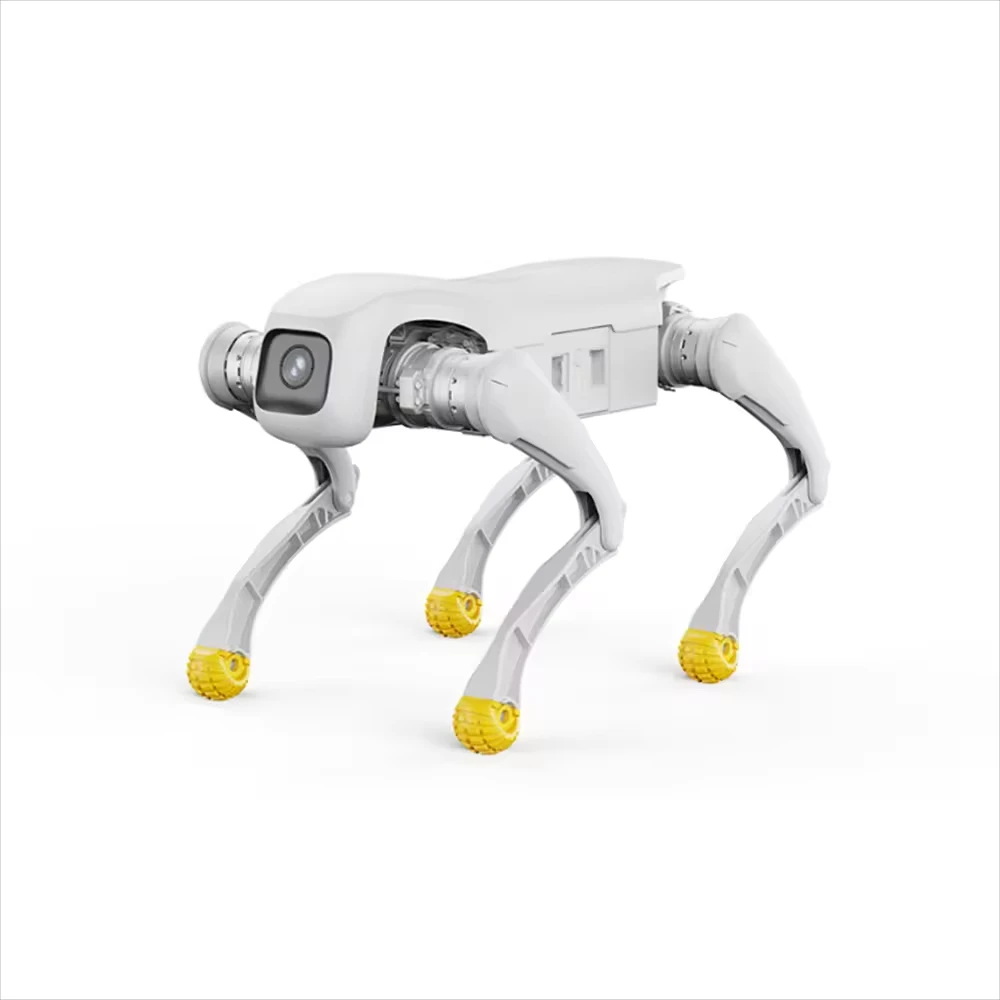
The AgiBot D1 robotic dog represents the latest evolution in accessible quadruped robotics, offering advanced AI capabilities, 12 degrees of freedom (12DOF), and educator-friendly programmability at a starting price of EUR 5,217.69 (down from EUR 7,453.84 at a 30% discount). As the consumer and education robotics market continues its rapid expansion, the AgiBot D1 enters a competitive landscape dominated by Boston Dynamics’ Spot and Unitree Robotics’ Go2, positioning itself as a mid-range option for developers, educators, and research institutions seeking capable robotic platforms without the USD 75,000 price tag of enterprise-grade alternatives.
This comprehensive review covers the D1’s hardware specifications, software ecosystem, AI capabilities, real-world applications, and market positioning. For importers and resellers, we also provide detailed guidance on sourcing, shipping, customs clearance, and compliance for high-value robotics products, which have unique logistical requirements compared to standard consumer electronics.
AgiBot D1 Robotic Dog: Hardware Specifications and Design
The AgiBot D1 robotic dog features a robust mechanical design centered around its 12 servo motors that provide independent joint control across four legs. Each leg has three degrees of freedom (hip, knee, and ankle joints), enabling the D1 to perform complex locomotion patterns including walking, trotting, running, stair climbing, and even dynamic recovery from pushes or trips. The joint actuators use brushless DC motors with harmonic drive reducers, providing a torque output of approximately 12 Nm per joint and a positioning accuracy within 0.2 degrees.
The D1’s chassis is constructed from aircraft-grade 6061 aluminum alloy with carbon fiber leg linkages, achieving a strength-to-weight ratio that supports its 12kg body while maintaining agility. The overall dimensions are approximately 650mm x 350mm x 450mm (LxWxH), making it comparable in size to a medium-sized dog. When folded for transport, the dimensions reduce to approximately 500mm x 300mm x 250mm, fitting into a standard carry-on luggage case.
The robot is powered by a hot-swappable 14.8V 6000mAh lithium-ion battery pack, providing approximately 2-3 hours of continuous operation under normal walking conditions. Battery charging takes approximately 90 minutes using the included 4A charger. The battery bay is accessible via a quick-release latch on the underside, allowing operators to extend runtime by carrying spare batteries. An optional tether power supply is available for extended stationary applications.
Sensor integration includes an Intel RealSense D435 depth camera for obstacle detection and mapping, a 6-axis IMU (Inertial Measurement Unit) for balance and orientation, four foot-mounted force sensors for terrain adaptation, and a forward-facing 4K RGB camera for visual recognition tasks. The depth camera provides accurate distance measurements from 0.2 to 10 meters with 1280×720 resolution, enabling the D1 to navigate complex indoor environments reliably.
Raspberry Pi Compute Module: Open-Source Programmability
One of the distinguishing features of the AgiBot D1 is its use of a Raspberry Pi Compute Module 4 as the main processing unit. This design choice makes the D1 significantly more accessible to developers and educators than proprietary robotics platforms that use custom, closed-source controllers. Developers can write control programs in Python, C++, or ROS (Robot Operating System) and deploy them directly to the D1 using standard development workflows.
The Raspberry Pi CM4 runs a custom Debian-based operating system that includes pre-installed libraries for quadruped locomotion control, sensor fusion, computer vision (OpenCV), and basic AI inference (TensorFlow Lite). AgiBot provides a comprehensive SDK with Python bindings and ROS 2 support, along with simulated environments in Gazebo and Isaac Sim that allow developers to test code without physical hardware. The documentation includes example scripts for basic movements (forward, backward, turn, sit, lie down) and intermediate tasks (stair climbing, obstacle avoidance, following a person).
The open architecture also means the D1 can be expanded with additional hardware. The CM4 module can be upgraded to the latest Raspberry Pi CM5 when available, providing a performance boost without replacing the entire robot. The expansion interface exposes I2C, SPI, UART, and GPIO pins, allowing developers to add custom sensors, LED arrays, robotic arms, or other peripherals. This modularity significantly extends the useful lifetime of the D1 compared to closed-platform competitors.
For importers, the Raspberry Pi compatibility is a key selling point that differentiates the D1 from competitors. The widespread availability of Raspberry Pi accessories, the large developer community, and the extensive online learning resources reduce the perceived risk for educational buyers who may be concerned about investing in a platform with limited support.

Smart AI Translation Bluetooth Earphones With LCD Display Noise Reduce New Wireless Digital Long Battery Life Display Headphone

Ai Translator Earbud Device Real Time 2-Way Translations Supporting 150+ Languages For Travelling Learning Shopping Business

TV98 ATV X9 Smart TV Stick Android14 Allwinner H313 OTA 8GB 128GB Support 8K 4K Media Player 4G 5G Wifi6 HDR10 Voice Remote iptv
AI Capabilities: Navigation, Recognition and Autonomous Operation
The AI capabilities of the AgiBot D1 are powered by a combination of the Raspberry Pi CM4 (for high-level planning and vision processing) and a dedicated STM32 microcontroller (for real-time motor control and stabilization). This split architecture ensures that complex AI tasks do not interfere with the critical low-level control loop, which runs at 1kHz for smooth and stable locomotion.
The D1 ships with pre-trained models for object detection, person following, gesture recognition, and voice command processing. The object detection model can recognize common household objects (chairs, tables, doors, stairs) and navigate around them using a built-in path planning algorithm. The person following feature uses visual tracking to maintain a consistent distance of 1-3 meters behind a target person, with automatic reacquisition if the target moves behind obstacles.
Gesture recognition supports five basic hand gestures (stop, follow, come, sit, wave) that can be used for intuitive interaction without requiring a phone app or laptop. Voice commands process through an onboard microphone array with noise cancellation, supporting both English and Mandarin commands out of the box. The response time for voice commands is approximately 500-800ms, which is adequate for basic control but slower than dedicated smart speakers.
Advanced users can train custom AI models using AgiBot’s training framework, which integrates with TensorFlow and PyTorch. The framework provides pre-configured model architectures optimized for the CM4’s limited compute resources, including MobileNet for visual tasks and TinyML models for sensor processing. Training is performed on a separate computer or cloud GPU, and the trained model is deployed to the D1 via USB or Wi-Fi.
Market Positioning: AgiBot D1 vs Unitree Go2 vs Boston Dynamics Spot
The quadruped robotics market has three primary tiers, and the AgiBot D1 occupies a strategic middle position between budget educational robots and enterprise-grade platforms. Understanding this positioning is critical for importers evaluating the product’s target market and sales potential.
AgiBot D1 (EUR 5,217) vs Unitree Go2 (EUR 1,200-3,500): The Unitree Go2 is the most direct competitor at roughly one-third to half the price. The Go2 offers similar 12DOF configuration, a slightly larger battery (8000mAh vs 6000mAh), and comparable Raspberry Pi-based architecture. However, the Go2 uses a less powerful Raspberry Pi 4B (vs CM4) and has lower torque servos (8 Nm vs 12 Nm). The D1’s advantages include higher joint torque, the depth camera (Go2 uses a simpler ultrasonic sensor), and more comprehensive SDK documentation. The Go2 wins on price and has a larger user community.
AgiBot D1 vs Boston Dynamics Spot (USD 75,000): There is no realistic comparison on specifications or capability. Spot offers industrial-grade durability, 90-minute battery with hot swapping, autonomous mission execution, comprehensive API compatibility, and enterprise support contracts. The D1 is not a Spot competitor; it is a learning and development platform that introduces users to quadruped robotics concepts at 7 percent of Spot’s cost. For importers, the D1’s target buyer is educational institutions, hobbyist developers, and research labs, not industrial or defense customers.
AgiBot D1 vs Xiaomi CyberDog 2 (CNY 12,999 / approx EUR 1,700): Xiaomi’s CyberDog 2 offers impressive specifications at a much lower price point due to Xiaomi’s scale and willingness to subsidize hardware. The CyberDog 2 features an NVIDIA Jetson NX module (significantly more powerful than the CM4) and 19 DOF. However, the CyberDog 2 is a loss leader for Xiaomi’s ecosystem and is not reliably available for international purchase, whereas the D1 is sold through standard distribution channels with shipping to most countries.
Importing High-Value Robotics: Logistics, Customs and Compliance
Importing a EUR 5,000+ robotic product requires careful attention to logistics and regulatory compliance that differs significantly from importing standard consumer electronics. Here are the critical considerations for importers planning to resell the AgiBot D1 or similar robotics products.
1. HS Code Classification: Quadruped robots are typically classified under HS Code 8479.50 (Industrial robots, n.e.s.) or 9503.00 (Toy models), depending on their marketed use case. The classification impacts duty rates (0-6% vs 0-4.9%) and whether additional regulatory scrutiny applies. Importers should request classification guidance from their customs broker and consider a binding tariff ruling from customs authorities to avoid reclassification surprises.
2. Battery and Dangerous Goods Shipping: The lithium-ion battery pack (14.8V, 6000mAh, 88.8Wh) exceeds the 20Wh threshold for standard air shipment and is near the 100Wh limit for special dangerous goods handling. The D1 must be shipped as Class 9 dangerous goods (UN 3481, Lithium Ion Batteries Contained in Equipment). This adds approximately EUR 50-150 per unit to shipping costs. Sea freight is simpler and cheaper but adds 25-35 days to transit.
3. CE and FCC Compliance: The D1 contains wireless modules (Wi-Fi, Bluetooth) that require CE RED (EU) or FCC Part 15 (US) certification. The Raspberry Pi CM4 module has its own certification, but the overall system integration requires testing. Request certification documents from the manufacturer and verify they cover the specific configuration being imported. Importers may need to arrange independent testing for EUR 2,000-4,000 per product variant.
4. Export Controls and Dual-Use Concerns: Quadruped robots with certain capabilities (autonomous navigation, payload capacity above 10kg, specific sensor types) may fall under dual-use export control regulations (EU Regulation 2021/821, US EAR). While the D1 is explicitly marketed for education and research, importers should confirm with the manufacturer that it does not require export licenses to their target market. This is particularly important for importers in countries with sanctions or restricted technology regimes.
5. Insurance for High-Value Shipments: At EUR 5,000+ per unit, a lost or damaged shipment represents a significant financial loss. Marine cargo insurance covering all risks (ICC-A) is strongly recommended at approximately 0.5-1 percent of the declared value. Verify that the insurance covers “breakdown during testing” exclusion, as some policies exclude damage that occurs during the inspection process.
For comprehensive customs clearance guidance, see our customs clearance playbook. Our landed cost calculator will help ensure all fees are properly accounted for.
Educational and Research Applications of the AgiBot D1
The primary market for the AgiBot D1 is educational institutions and research laboratories that need a capable robotic platform for teaching robotics, AI, and control systems. The D1 is well-suited for several specific educational contexts.
University Robotics Programs: Undergraduate and graduate courses in robotics, mechatronics, and computer science can use the D1 as a hands-on platform for teaching locomotion control, sensor fusion, computer vision, and AI planning. The ROS 2 compatibility means students can transfer skills learned on the D1 to industrial robotics systems, improving the practical value of their education. At EUR 5,217, a university can equip a lab with 5-10 D1 units for the cost of a single Boston Dynamics Spot.
Research Applications: The D1’s open architecture and expandable sensor suite make it suitable for research projects in legged locomotion, multi-robot coordination, and human-robot interaction. Researchers have already published papers using the D1 for SLAM (Simultaneous Localization and Mapping) algorithm testing and adaptive gait control on varying terrain.
STEM Education: High schools and STEM centers can use the D1 for advanced robotics projects that go beyond wheeled robot kits like LEGO Mindstorms or VEX. The Python programming interface is accessible to students with basic coding experience, and the visual AI features provide compelling demonstrations for science fairs and open-house events. Some suppliers offer educational bundle packages with curriculum guides, spare parts kits, and multi-unit discounts for educational institutions.
Frequently Asked Questions About the AgiBot D1 Robotic Dog
Q1: What programming languages are supported by the AgiBot D1?
Python is the primary programming language, supported through comprehensive SDK documentation with example scripts. The D1 also supports C++ for performance-critical applications and ROS 2 (Robot Operating System) for advanced robotics development. The ROS 2 support allows integration with a wide ecosystem of existing robotics libraries and tools.
Q2: Can the AgiBot D1 carry payloads?
Yes, the D1 can carry payloads up to approximately 3kg on its back mounting plate. The mounting plate uses a standard 1/4-inch camera screw pattern and also has M3 threaded holes for custom mounting solutions. Common payloads include additional sensors (LiDAR, thermal cameras), a robotic arm, or communication equipment.
Q3: What is the maximum speed and what terrain can it handle?
The D1 can walk at speeds up to 1.2 m/s (4.3 km/h) on flat surfaces and 0.5 m/s on stairs. It can climb stairs with standard dimensions (riser height under 20cm, tread depth over 25cm), traverse slopes up to 30 degrees, and walk over small obstacles up to 10cm in height. The robot is not designed for outdoor all-terrain use like the Boston Dynamics Spot, but it can operate on grass, gravel, and tile surfaces.
Q4: Is the AgiBot D1 suitable for beginners?
The D1 is designed for intermediate users with some programming experience. Beginners can use pre-loaded demo programs to explore basic functionality, but unlocking the full capabilities requires Python programming knowledge. AgiBot recommends the D1 for users with at least basic Python experience or access to a mentor who can guide the learning process.
Q5: What is the warranty and support for international buyers?
The standard warranty is 12 months for manufacturing defects. International shipping costs for warranty repairs are typically shared between buyer and seller. A spare parts kit (extra servo motors, cables, screws) is available for approximately EUR 300. Technical support is provided via email and a community forum, with response times of 24-48 hours. Educational institutions may negotiate extended warranty terms as part of bulk purchase agreements.
Conclusion: Is the AgiBot D1 a Good Investment?
The AgiBot D1 robotic dog represents a thoughtfully designed mid-range quadruped robot that fills a genuine gap between budget educational bots and enterprise-grade platforms. Its use of the Raspberry Pi CM4, comprehensive ROS 2 support, 12 Nm joint torque, and depth camera integration make it a capable platform for education and research at a price point that is accessible to well-funded institutions and serious hobbyists.
For importers, the robotics category requires more specialized logistics and higher investment than standard consumer goods, but the rewards include higher margins (30-40 percent is achievable for established resellers), less price competition, and customers who are more loyal and less likely to return products. The education channel, in particular, offers repeat business through curriculum updates, spare parts sales, and multi-unit orders.
For further reading, see our guides on product sourcing strategies, supplier verification, and marketplace selection for high-value products.





