








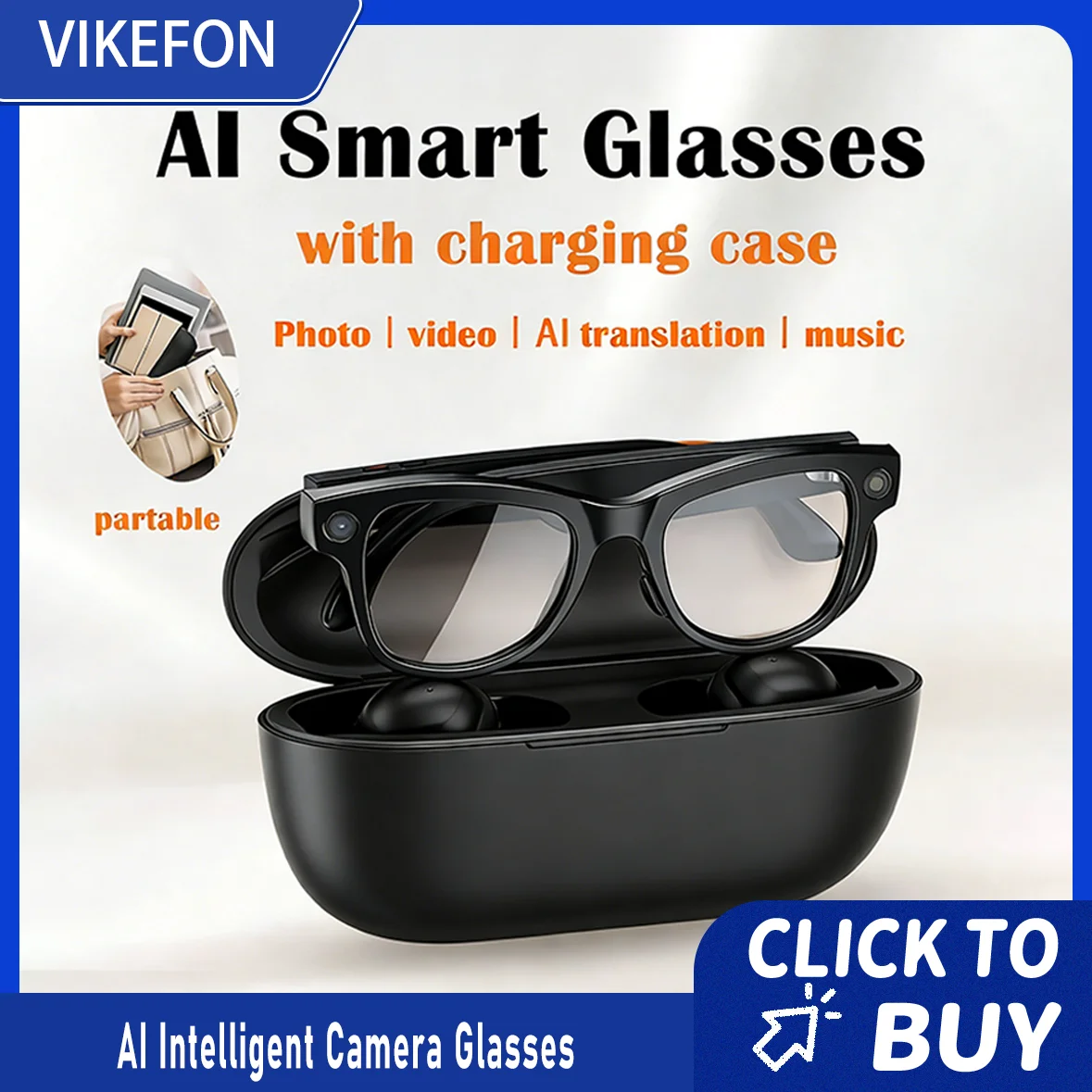
The wearable AI device market is experiencing explosive growth, and sourcing AI smart glasses for import represents one of the most exciting emerging opportunities for cross-border e-commerce sellers in 2026. Modern AI smart glasses like the M02 model integrate 8MP cameras, video recording, real-time translation across 100+ languages, Bluetooth calling, music playback, and a convenient charging case into a design that looks like ordinary sunglasses. These devices sit at the intersection of multiple high-growth categories — wearable technology, AI-powered translation, personal security cameras, and smart accessories. For small importers, AI smart glasses offer the advantages of compact size for shipping, high perceived value at price points of $50-$150, and rapidly growing consumer awareness as the product category gains mainstream visibility through media coverage and influencer promotion.
Why AI Smart Glasses Are a Fast-Growing Import Category
The smart glasses market was valued at over $12 billion globally in 2025 and is projected to grow at a 20-25% CAGR through 2030, driven by advances in miniaturization, battery technology, and AI processing at the edge. The wearable AI camera segment — glasses that combine cameras, translation, and audio capabilities — is the fastest-growing subcategory as prices drop below the $100 threshold that triggers mass-market adoption. Travelers, business professionals, content creators, and security-conscious consumers are the primary buyer segments, each finding different value propositions in the same device. For travelers, real-time language translation is transformative — simply speak in one language and hear the translation through the glasses’ speakers. For content creators and life-loggers, the hands-free first-person video perspective captures experiences naturally. For parents and individuals concerned about personal security, the ability to discreetly record video provides peace of mind.
For importers, the category economics are compelling. Factory pricing for AI smart glasses ranges from $25-$40 for photo-capture-only models to $45-$80 for full-featured models with video recording, translation, Bluetooth audio, and charging cases. MOQs range from 500-2000 units. The products are compact — folding glasses plus charging case fit in a pocket — keeping shipping costs at $2-$5 per unit. The category benefits from the global travel recovery, with international tourism projected to exceed pre-pandemic levels by 2026, creating a large addressable audience for translation-equipped smart glasses. The technology also benefits from continuous software improvement — translation accuracy, voice recognition quality, and battery optimization improve over time through firmware updates, actually increasing product value after purchase. Relatively low return rates of 4-8% reflect the category’s high satisfaction when products meet basic quality thresholds.
Key Specifications to Evaluate When Sourcing AI Smart Glasses
When evaluating AI smart glasses for import, camera quality and field of view are the primary technical differentiators. The camera sensor should offer at least 8MP for photos (3264×2448 resolution) and 1080p video recording at 30fps minimum. The field of view (FOV) should be 60-80 degrees to capture a natural first-person perspective without excessive distortion or the fisheye effect that cheap cameras produce. Low-light performance matters enormously — look for sensors with larger pixel sizes (1.4 microns or larger) and f/2.0 or wider aperture for acceptable indoor and evening recordings. Video stabilization is essential for useful footage — electronic image stabilization (EIS) is acceptable for walking shots, while optical stabilization (OIS) is preferable for more active use. The sample photos and videos should look natural without excessive digital noise, color shift, or compression artifacts.
AI translation capability is the other headline feature that requires careful verification. Translation accuracy in real-world conditions depends on microphone quality, ambient noise handling, and the speech recognition engine. Test the translation feature in a moderately noisy environment (cafe-level background noise of 60-70 dB) with non-native accented English, as this represents real-world usage conditions. Translation latency should be under 2-3 seconds for natural conversation flow. Language coverage should genuinely support 100+ languages for text translation, with at least 40 languages supporting real-time voice translation — some budget models claim 100+ languages but only support 10-15 for voice. The offline translation capability is a meaningful differentiator for travelers without reliable internet — verify that commonly requested languages (English, Chinese, Spanish, French, German, Japanese) work without a phone connection.

TV98 ATV X9 Smart TV Stick Android14 Allwinner H313 OTA 8GB 128GB Support 8K 4K Media Player 4G 5G Wifi6 HDR10 Voice Remote iptv

Smart AI Translation Bluetooth Earphones With LCD Display Noise Reduce New Wireless Digital Long Battery Life Display Headphone

Ai Translator Earbud Device Real Time 2-Way Translations Supporting 150+ Languages For Travelling Learning Shopping Business
How to Source AI Smart Glasses from Reliable Manufacturers
Sourcing AI smart glasses requires manufacturers that combine optical engineering (sunglass lens production, frame design), consumer electronics (camera modules, Bluetooth audio, battery integration), and embedded AI software (speech recognition, translation engines, camera processing). Shenzhen and Guangzhou are the primary production hubs, with some specialized optical factories in Wenzhou and Xiamen. Start your search on Alibaba using keywords like “AI smart glasses,” “smart translation glasses,” “camera sunglasses,” “Bluetooth audio glasses,” and “wearable video glasses.” Filter for suppliers with verified factory audits and at least 3 years of experience in wearable electronics. Request samples from 3-5 shortlisted suppliers and conduct thorough testing: compare photo and video quality across lighting conditions, verify translation accuracy across multiple languages, test Bluetooth pairing and audio quality, measure battery life for each usage mode, and evaluate comfort for extended wear (2+ hours).
A critical factor specific to smart glasses is companion app quality. The mobile app (iOS and Android) is the user interface for camera control, video playback, translation management, and firmware updates. A poorly designed app with crashes, connection drops, or confusing navigation will generate negative reviews regardless of hardware quality. Test the app extensively: initial Bluetooth pairing process, live view latency, file transfer speed (videos can be large), translation interface usability, and firmware update reliability. The app should be available on both Apple App Store and Google Play Store with recent update history indicating active development. For comprehensive supplier vetting, read our guide on how to find reliable suppliers for your small business in under two weeks and our detailed supplier verification and factory audit guide.
Battery Life and Charging Case Considerations
Battery performance is one of the most important practical considerations for AI smart glasses, directly impacting user satisfaction and reviews. The device must survive a full day of use — minimum 4-6 hours of active recording/translation mode and 12+ hours of Bluetooth standby. The battery in the glasses frame is necessarily small due to form factor constraints (typically 150-300 mAh), which is why the charging case is essential. The case should provide at least 3-4 full charges for the glasses, bringing total-use time to 16-24 hours — enough for a multi-day trip without wall charging. The case’s battery capacity should be clearly specified (2000-5000 mAh for standard models). USB-C charging for both the case and direct glasses charging is expected. Fast charging capability — 15 minutes of charging providing 1+ hours of use — is a meaningful differentiator that reviewers consistently note positively.
Battery safety certification is non-negotiable for this category. The lithium-ion batteries in both the glasses and charging case must have UN38.3 certification for air transport and IEC 62133 certification for consumer safety. The charging case itself must have overcharge protection, short circuit protection, and temperature regulation. Poor quality charging cases have been linked to fire incidents, making certification documentation essential for liability protection and platform compliance. Request battery certification test reports from your supplier and verify the reports against the issuing laboratory’s database. Some suppliers use battery cells from different manufacturers than those specified in certification documents — verify product certification matches actual delivered units during factory inspection. For customs clearance procedures, refer to our small importer’s customs clearance playbook.
Pricing Strategy and Profit Margins for Smart Glasses Importers
Understanding your landed cost is essential for pricing AI smart glasses profitably. Factory pricing ranges from $25-$40 for basic photo-only glasses with Bluetooth audio to $45-$80 for full-featured models with 1080p video, 100+ language translation, and premium charging cases. MOQs typically range from 500-1000 units. Shipping at $3-$6 per unit via sea freight or $5-$10 via air freight keeps logistics reasonable. Customs duties for wearable electronics under HS code 9004.90 (spectacles and goggles) or 8517.62 (communication devices) range from 2-8%. Platform fees take 8-15%. After full cost accounting, target retail prices of $60-$150 to achieve 40-55% gross margins, yielding 15-25% net margins.
Market positioning in the AI smart glasses category is evolving rapidly as consumer awareness grows. The sub-$100 price point currently sees highest conversion as consumers experiment with the new category. At $60-$90, emphasize translation capability, camera quality, and design aesthetics. Above $100, the product must offer premium build quality, superior camera performance, and extended battery life to compete. Invest in product photography showing the glasses worn naturally alongside the charging case and demonstrating real-world use scenarios: a traveler speaking with a local in a foreign language, a parent capturing a child’s school performance hands-free, a cyclist navigating with audio directions. Infographics comparing camera field of view, supported languages, and battery life against competitors justify premium pricing. For marketplace selection strategy, read our comparison of eBay vs Amazon vs Etsy selling strategies. For complete cost analysis, use our importer’s cost calculation workbook.
Privacy and Regulatory Compliance for Camera-Equipped Glasses
AI smart glasses with built-in cameras and microphones face heightened regulatory and privacy scrutiny compared to most consumer electronics. In the US, FCC Part 15 certification for wireless devices (Bluetooth) and digital device emissions is mandatory. The camera module may also need FCC labeling for specific SAR (Specific Absorption Rate) testing if it includes wireless video transmission. In the EU, CE marking requires compliance with the Radio Equipment Directive (RED 2014/53/EU), EMC Directive, RoHS Directive, and potentially the General Product Safety Directive. The battery and charging case require additional certification. For the UK, UKCA marking is required. Australia requires RCM marking. Privacy is a growing regulatory focus — the European Union is considering specific AI wearable legislation that could affect smart glasses with recording capabilities.
Privacy law compliance goes beyond product certification. The camera’s recording indicator light is legally required in many jurisdictions — a visible LED that illuminates whenever video or audio is being recorded. The device should also respect local privacy laws regarding recording of individuals without consent. Product documentation and packaging should include clear guidance on responsible usage in accordance with applicable recording laws, which vary significantly between countries. The companion app should comply with GDPR (Europe), CCPA (California), and other data privacy regulations regarding user data collection and storage. Consider including a privacy filter lens cap or magnetic cover that physically covers the camera when not in use — this visible privacy feature is appreciated by privacy-conscious consumers and can be a selling point that differentiates your product from unbranded competitors. For further guidance on product compliance, refer to our customs clearance playbook.
Frequently Asked Questions About Importing AI Smart Glasses
Q1: What is the typical MOQ for AI smart glasses with translation and camera features?
Most factories require MOQs of 500-1000 units for standard models. Custom frame colors or polarized lens options typically require 1000+ units. Sample orders of 5-10 units are available from most suppliers.
Q2: How do I verify the translation accuracy of AI smart glasses samples?
Test with 10 common travel phrases in English, Spanish, French, Mandarin, and Japanese (or your target languages). Record and compare translation accuracy. Check for real-time translation mode (voice-to-voice) vs. app-based translation. Test in quiet and moderately noisy environments.
Q3: Are there privacy laws I need to consider when selling camera glasses?
Yes. Many jurisdictions require visible recording indicators when the camera is active. Selling in Europe requires GDPR compliance for the companion app. Include clear product documentation about legal recording use in your target markets and a camera privacy shutter.
Q4: What certifications are required for AI smart glasses with Bluetooth?
FCC ID for US markets (covering Bluetooth and digital emissions), CE RED for Europe (covering radio equipment), UKCA for UK, and RCM for Australia. Additionally, battery certification (UN38.3, IEC 62133) is required for the glasses and charging case.
Q5: Can AI smart glasses be used with prescription lenses?
Most models are designed as over-glasses or come with a prescription lens frame adapter. Verify that your chosen supplier offers prescription-friendly design or can provide clip-on prescription frames. This feature significantly expands your addressable market to eyeglass wearers.
Related Articles
How to Find Reliable Suppliers for Your Small Business in Under Two Weeks
From Random Products to Reliable Sales: A Small Items Sourcing Plan That Delivers Profit
eBay vs Amazon vs Etsy: Which Online Marketplace Selling Strategy Wins for Small Importers




