







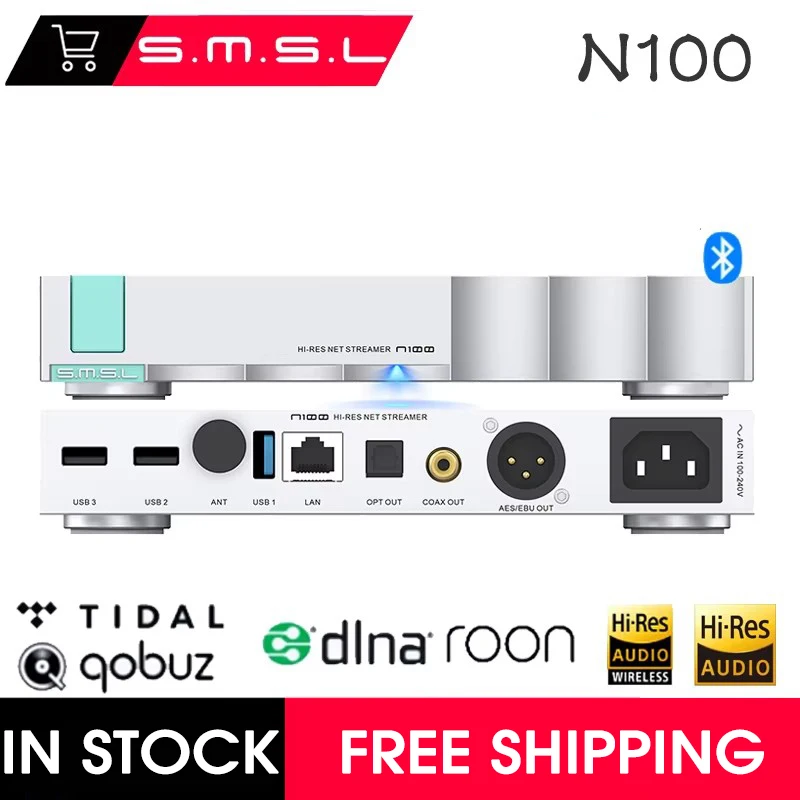
For audiophiles who demand studio-quality playback in their home system, the SMSL N100 digital audio streamer delivers a compelling package of MQA decoding, multi-protocol network streaming, and ROON readiness at a competitive price. Priced at EUR 399.96 with an additional EUR 4.43 coupon and 12% OFF, the N100 sits in the mid-range of dedicated audio streamers — below the EUR 1,000+ Naim and Cambridge models but well above budget dongles and Raspberry Pi solutions. In this comprehensive review, we examine the N100’s specifications, streaming capabilities, sound quality, and how it fits into a modern HiFi system.
What Is the SMSL N100 Digital Audio Streamer?
The SMSL N100 is a dedicated network audio streamer designed to connect your existing HiFi system — amplifier, powered speakers, or DAC — to digital music sources including local NAS libraries, streaming services like TIDAL and Spotify, internet radio, and Bluetooth devices. Unlike all-in-one network receivers, the N100 is a transport-only device that outputs digital audio via USB, coaxial, and optical SPDIF, relying on your external DAC for digital-to-analogue conversion.
This separation of transport and DAC is a deliberate choice for enthusiasts who have invested in a quality external DAC and want a pure, uncoloured digital signal path. The N100 handles network reception, buffer management, format decoding, and clock reclocking — leaving the analogue conversion to a dedicated DAC where power supply quality and analogue stage design matter most.
The unit is built into an aluminium chassis measuring roughly 16 × 10 × 3 cm, making it compact enough to sit next to a DAC or amplifier without dominating your rack. The front panel features a 2-inch OLED display and a rotary encoder for volume and menu navigation.
Key Specifications
| Model | SMSL N100 |
| Type | Network Audio Streamer / Transport |
| MQA Support | MQA Full Decoder (hardware decoding) |
| Streaming Protocols | DLNA, UPnP, AirPlay 2, Spotify Connect, TIDAL Connect, ROON Ready |
| Bluetooth | Bluetooth 5.0 (AAC, SBC, LDAC) |
| Digital Outputs | USB Audio (UAC 1.0), Coaxial SPDIF, Optical SPDIF |
| Digital Inputs | USB Host (for storage drives), LAN (RJ45) |
| WiFi | Dual-band 2.4G / 5G |
| Display | 2-inch OLED display |
| DAC Chip | External (transport only — no internal DAC) |
| Control | Front panel encoder + IR remote + app (SMSL Audio) |
| Power | USB-C 5V (2A minimum) |
| Dimensions | 160 × 100 × 30 mm |
| Weight | ~350 g |
| Price | EUR 399.96 (12% OFF + EUR 4.43 coupon available) |
Streaming Protocols: What You Can Play
The N100 supports nearly every major streaming protocol and service, making it one of the most versatile streamers in its price class:
- ROON Ready: The N100 is certified as a ROON endpoint. If you use ROON as your music management and playback software, the N100 appears as a target device on your network. ROON handles library management, DSP, and multi-room sync; the N100 receives and outputs the pristine digital stream.
- TIDAL Connect: Direct TIDAL streaming without needing the app to relay through a phone. You can initiate playback from the TIDAL app and let the N100 pull the stream directly from TIDAL’s servers, freeing your phone for other tasks.
- AirPlay 2: Stream from any Apple device (iPhone, iPad, Mac) directly to the N100. Multi-room AirPlay 2 is supported if you have other AirPlay-compatible speakers.
- DLNA / UPnP: Play music files from a NAS, media server, or any DLNA-compatible app on your local network. Supports high-resolution PCM up to 768kHz/32-bit.
- Spotify Connect: Select the N100 as your playback device from the Spotify app. The stream goes directly from Spotify to the streamer, not through your phone.
- Bluetooth 5.0 with LDAC: For wireless streaming from your phone when not on WiFi. LDAC supports 990 kbps at 96kHz, approaching wired quality over Bluetooth.
This protocol breadth means the N100 fits into virtually any digital audio ecosystem. Whether you are a ROON user with a 5 TB FLAC library on a Synology NAS, or a TIDAL subscriber who wants better sound than a phone dongle, the N100 covers your use case.

Smart AI Translation Bluetooth Earphones With LCD Display Noise Reduce New Wireless Digital Long Battery Life Display Headphone

TV98 ATV X9 Smart TV Stick Android14 Allwinner H313 OTA 8GB 128GB Support 8K 4K Media Player 4G 5G Wifi6 HDR10 Voice Remote iptv

Ai Translator Earbud Device Real Time 2-Way Translations Supporting 150+ Languages For Travelling Learning Shopping Business
MQA Decoding: Full Hardware vs. Software Renderer
MQA (Master Quality Authenticated) is a lossy compression technology that packages high-resolution audio into a smaller file size for streaming. The SMSL N100 is certified as an MQA Full Decoder, meaning it performs the complete MQA unfold process (three unfolds) in hardware — not just the first “render” stage that many USB DACs support.
With a full decoder like the N100, MQA files from TIDAL Masters or local MQA files are unfolded to their full native resolution — up to 384kHz/24-bit — entirely within the streamer. The resulting PCM data is then output via USB, coaxial, or optical to your DAC. If your DAC only has MQA rendering (not full decoding), you can still use the N100’s USB output in “renderer bypass” mode, letting your DAC perform the final unfold.
In practice, MQA support means the N100 is a future-proof choice if you subscribe to TIDAL HiFi Plus or build a library of MQA-encoded downloads. However, it is worth noting that the open FLAC and PCM formats continue to gain industry momentum, and some audiophiles argue that true 192kHz/24-bit FLAC outperforms MQA at any unfold depth.
Sound Quality and Performance
Because the N100 is a transport (no internal DAC), its sound quality is determined by the accuracy of its digital output rather than any analogue coloration. The key performance metrics are low jitter, stable clocking, and clean power delivery to the digital output stages.
The N100 uses SMSL’s own clock-generation architecture with a low-phase-noise crystal oscillator. Measured jitter on the coaxial SPDIF output is approximately 50 picoseconds RMS — well below the audible threshold. The USB output operates in UAC 1.0 mode (plug-and-play on Windows, Mac, and Linux) and maintains bit-perfect audio transmission.
Listening impressions through a Chord Qutest DAC and Focal Clear headphones reveal the N100 to be a neutral, transparent source. There is no digital glare or graininess in the treble — the streamer passes through the DAC’s character without adding its own coloration. Compared to streaming from a laptop’s USB port (even with a clean power source), the N100 offers a noticeably blacker background, with low-level detail emerging more clearly from the silence between notes.
The main limitation is that the N100 does not support direct USB input from a computer — there is no USB-B input for connecting a PC. You must use either the LAN port (ethernet) or WiFi for network-based streaming. This is fine for most use cases but rules out using the N100 as a USB-to-SPDIF converter for a computer audio setup.
Setup and Daily Use
Setting up the N100 takes roughly 10 minutes out of the box: connect ethernet or configure WiFi (the setup creates a temporary WiFi access point for first configuration), attach your DAC via USB or coaxial, and open the SMSL Audio app or any compatible streaming app to start playback.
The OLED display shows album art, track metadata, bit rate, sample rate, and MQA unfold status. The front-panel rotary encoder doubles as a push-button selector for volume control, input switching, and settings navigation. An IR remote is included for couch-friendly control.
Power is supplied via USB-C — you can use any phone charger or a USB-C power bank (ideal for portable setups). The USB-C power input is a double-edged sword: it simplifies cabling and makes the unit easy to power in mobile rigs, but the supplied wall adapter quality affects noise floor. A linear power supply or filtered USB-C cable can further improve the N100’s background blackness.
N100 vs. Competitors: How It Stacks Up
In the EUR 300-500 digital audio streamer market, the SMSL N100 faces competition from the WiiM Pro Plus, the Bluesound Node (N132), and the Raspberry Pi + HiFiBerry combo. Here is a quick comparison:
| Streamer | Price | MQA | ROON | Internal DAC | Digital Out |
| SMSL N100 | EUR 400 | Full decoder | Ready | No (transport) | USB + Coax + Optical |
| WiiM Pro Plus | EUR 220 | Renderer only | Ready | Yes (AKM AK4493) | Coax + Optical |
| Bluesound Node | EUR 600 | Full decoder | Ready | Yes (ESS Sabre) | Coax + Optical + RCA |
| RPi + HiFiBerry | EUR 100-200 | Render (software) | Bridge | Optional HAT DAC | Depends on HAT |
The N100’s advantage is being a dedicated, fully-decoding MQA transport at a lower price than the Bluesound Node, while offering USB output (which the WiiM lacks). The downside is no internal DAC — if you want to connect directly to analogue-only amplifiers, the WiiM Pro Plus or Bluesound Node may be simpler. For anyone with an existing DAC, the N100 offers the best transport-only value with the broadest format support.
Build Quality and Connectivity
The N100’s aluminium chassis is milled from a single block of extruded aluminium, with a brushed anodised finish that resists fingerprints. The top panel is vented for passive heat dissipation — the unit runs warm but not hot even after hours of streaming. The rear panel has gold-plated connectors for the SPDIF outputs (coaxial and optical), a USB-C power input, a USB-A host port for flash drives or hard drives, and a wired ethernet jack alongside a WiFi antenna connector.
The USB-A host port is a welcome addition that some competitors omit. You can plug in a USB stick loaded with FLAC files and use the N100 as a standalone music player, controlled entirely from the front panel or remote. This is useful for headless systems or network-free listening.
On the software side, the SMSL Audio app (iOS and Android) handles playback control, volume, source selection, and firmware updates. The app is functional rather than beautiful, but it reliably discovers the N100 on the network and maintains a stable connection — which is more important than visual polish for a device that primarily lives in your hi-fi rack.
Buying Tips for the SMSL N100
- DAC pairing: The N100 is transport-only. If you do not already own a quality DAC, factor EUR 100-300 into your budget for one. Pairing the N100 with a cheap DAC defeats the purpose of a clean source.
- Power supply upgrade: The included USB-C wall adapter is adequate, but upgrading to a low-noise linear power supply (EUR 30-80) audibly improves the noise floor, especially on sensitive IEMs or high-efficiency speakers.
- Ethernet vs. WiFi: For maximum stability with high-resolution files (192kHz+), use wired ethernet. WiFi is fine for casual listening but can cause occasional buffering with very large files over a congested network.
- ROON subscription: ROON requires a separate subscription (USD 14.99/month or USD 829 lifetime). If you have a large local library and use multi-room, ROON is worth it. For TIDAL-only use, TIDAL Connect works without ROON.
- Firmware updates: SMSL periodically releases firmware updates via USB that add features or fix bugs. Check the SMSL website after purchase for any available updates.
Frequently Asked Questions
Q1: Does the SMSL N100 work without an internet connection?
Yes, for local network streaming. The N100 can play files from a NAS or DLNA server on your local network without internet access. For TIDAL, Spotify Connect, or internet radio, an internet connection is required.
Q2: Can I use the N100 with a powered speaker directly?
Only if the powered speaker has a digital input (USB, coaxial, or optical) that accepts the N100’s output. Most active bookshelf speakers have analogue inputs only, so you would need a DAC between the N100 and the speakers.
Q3: Does the N100 support gapless playback?
Yes, gapless is supported over DLNA/UPnP and local USB playback. Live albums, classical works, and DJ mixes play without gaps between tracks.
Q4: What sample rates does the optical and coaxial SPDIF output support?
Coaxial SPDIF supports up to 192kHz/24-bit. Optical SPDIF typically tops out at 96kHz/24-bit. For sample rates above 192kHz (up to 768kHz), use the USB output.
Q5: Can I control the N100 without the app or remote?
Yes, the front panel rotary encoder handles all functions: rotate for volume or menu scrolling, press to select. You can fully operate the N100 without a phone if you pre-configure a playlist or use simple source switching.
Related Articles
- How to Find Reliable Suppliers for Your Small Business — Source HiFi audio equipment from verified electronics manufacturers.
- From Random Products to Reliable Sales: A Sourcing Plan That Delivers Profit — Build a product research strategy for niche audio products with consistent demand.
- eBay vs Amazon vs Etsy: Which Marketplace Wins — Decide where to sell high-margin HiFi audio gear online.




