








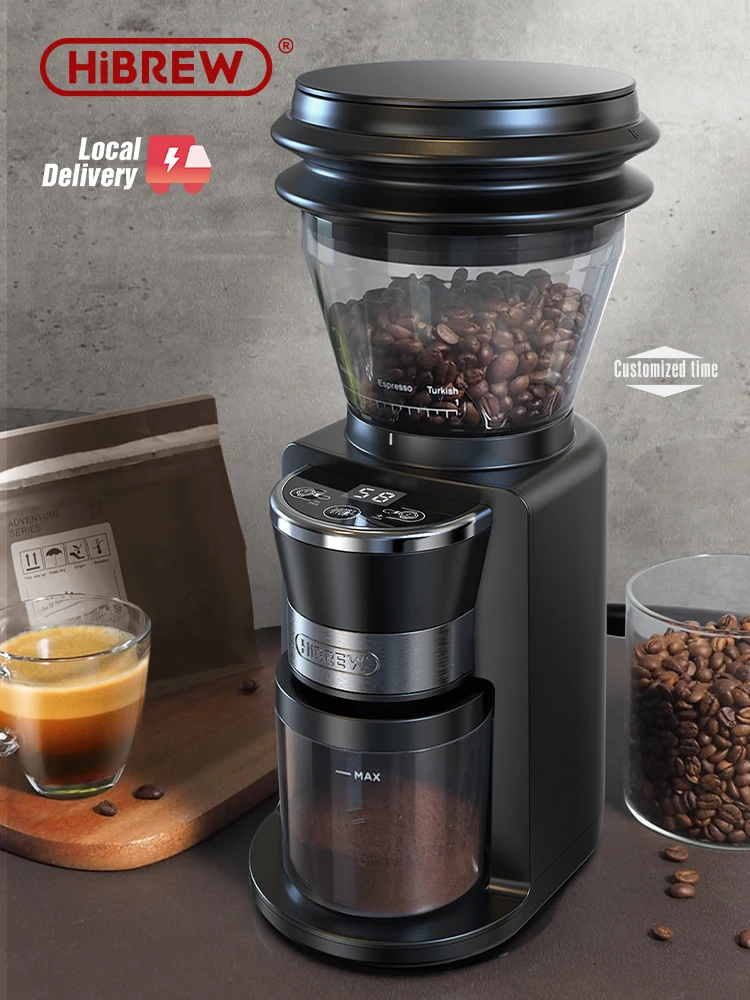
The electric coffee grinder market is experiencing strong growth driven by the global rise of home specialty coffee culture, and sourcing electric coffee grinders for import represents a lucrative opportunity for cross-border e-commerce sellers in 2026. Models like the HiBREW G3 with 31 grind settings demonstrate how far affordable electric grinders have come — offering precise grind control suitable for espresso, pour over, drip coffee, and French press in a single device. For small importers, coffee grinders hit a sweet spot: they are compact enough for cost-effective shipping, carry a high perceived value per unit, and appeal to a passionate consumer base that actively researches and invests in quality equipment. This guide walks through everything you need to know to source, verify, and sell electric coffee grinders profitably on online marketplaces.
Why Electric Coffee Grinders Are a Strong Import Category in 2026
The global coffee grinder market was valued at approximately $2.8 billion in 2025, with electric grinders accounting for over 65% of revenue. The category is projected to grow at a CAGR of 6-8% through 2030, fueled by several converging trends. The work-from-home shift permanently increased at-home coffee consumption, and consumers who upgraded their coffee habits during that period are now seeking better equipment to elevate their daily brew. Specialty coffee culture has expanded well beyond major metropolitan areas, with consumers in suburban and rural markets actively seeking tools — including quality electric grinders — that were previously only available in specialty coffee shops. The rise of single-origin and artisanal coffee consumption has created demand for grinders that can produce consistent, adjustable particle sizes, since bean freshness and grind consistency are the two most important variables in coffee quality.
For importers, the electric coffee grinder category offers favorable unit economics. Quality electric grinders with 15-40 grind settings retail for $50-$150, yielding wholesale costs of $18-$45 per unit at MOQs of 500-2000 pieces. The products are relatively compact — most models measure 8-12 inches in height and weigh 2-4 pounds — which keeps per-unit shipping costs manageable via both sea and air freight. The category also benefits from year-round demand that spikes during holiday gifting seasons (November-December) and coffee appreciation events. Because coffee grinders are frequently used daily and eventually wear out, there is a natural replacement cycle of 3-5 years that creates recurring demand. For sellers who can establish positive reviews and rankings in this category, the long-term customer lifetime value is attractive.
Key Features to Evaluate When Sourcing Electric Coffee Grinders
When evaluating electric coffee grinders for import, the number of grind settings is the most visible specification but far from the only important one. Burr material is arguably more critical — ceramic burrs stay sharper longer than steel burrs and generate less heat during grinding, which preserves coffee oil and flavor compounds. Steel burrs are more durable for high-volume commercial use but can transfer heat to the grounds. Look for conical burr designs rather than flat burrs, as conical burrs produce more uniform particle distribution — the key to consistent extraction. Motor power should be at least 150 watts for reliable grinding across all coarseness levels, with thermal overload protection to prevent motor damage during extended use sessions. The grind chamber should be static-dissipative or include an anti-static coating to prevent grounds from clinging to surfaces, a common frustration with budget grinders.
Bean hopper capacity is another practical consideration — 200-300 grams is standard for home use and sufficient for 2-4 weeks of daily brewing for a typical household. The grind size adjustment mechanism should be stepless or offer enough micro-adjustments to dial in espresso precisely, since espresso is the most grind-sensitive brewing method. Noise level at maximum rpm should be below 75 dB for residential acceptability. Safety features including lid-lock mechanisms (grinder cannot operate unless the lid is properly seated) and non-slip silicone feet are important for liability reduction. For the HiBREW G3 specifically, the 31-gear adjustment system and visual bean storage are standout features that allow users to see remaining beans at a glance — a design element that resonates well with coffee enthusiasts who value workflow transparency.

Ai Translator Earbud Device Real Time 2-Way Translations Supporting 150+ Languages For Travelling Learning Shopping Business

Smart AI Translation Bluetooth Earphones With LCD Display Noise Reduce New Wireless Digital Long Battery Life Display Headphone

TV98 ATV X9 Smart TV Stick Android14 Allwinner H313 OTA 8GB 128GB Support 8K 4K Media Player 4G 5G Wifi6 HDR10 Voice Remote iptv
How to Source Coffee Grinders from Reliable Factories
Sourcing electric coffee grinders requires finding a supplier that combines small appliance manufacturing expertise with precise machining capability for burr production. Start your search on Alibaba and Made-in-China using keywords like “electric coffee grinder,” “burr coffee grinder,” “conical burr grinder,” and “coffee mill grinder.” Filter for suppliers verified by third-party inspection services and those with at least 5 years of experience in the small kitchen appliance sector. Request samples from 3-5 shortlisted suppliers and conduct systematic testing: run 500 grams of medium-roast beans through each grinder and measure particle distribution uniformity using a sieve set, test consistency across all grind settings, run continuous grinding for 30 minutes to test motor thermal management, and check noise levels with a decibel meter.
A critical quality indicator to verify is the burr alignment tolerance. Poorly aligned burrs produce uneven particle sizes and create excessive fines (dust-like particles) that lead to bitter, over-extracted coffee. Request the factory’s burr alignment QA documentation and test the sample by grinding exactly 18 grams of coffee at the same setting three times, weighing the output to check for consistency. Electrical safety certifications are mandatory — UL or ETL for the US market, CE and UKCA for European markets, and SAA for Australia. The power supply voltage must match your target market (110-120V for North America, 220-240V for Europe/Asia). For comprehensive supplier vetting procedures, read our guide on how to find reliable suppliers for your small business in under two weeks and our deep dive on supplier verification and factory audits.
Grind Consistency: The Quality Benchmark That Drives Reviews
In the coffee grinder category, grind consistency is the single most important quality metric because it directly determines coffee extraction quality. Inconsistent grinds produce both under-extracted (sour) and over-extracted (bitter) flavors in the same cup, which even novice coffee drinkers can detect after experiencing a properly ground brew. The industry standard for measuring grind consistency is particle size distribution analysis, typically expressed as the percentage of particles within +/- 100 microns of the target size. Professional-grade grinders achieve 80%+ uniformity; good consumer electric grinders in the $80-$150 range should achieve 65-75% uniformity at medium grind settings. Budget blade grinders typically achieve below 40% uniformity, which is why they produce such poor coffee.
For importers, this presents both a challenge and an opportunity. The challenge is that grind consistency varies widely between factories and even between production batches from the same factory. The opportunity is that selling grinders with documented consistency data is a powerful competitive advantage. Consider investing in a simple sieve shaker set (approximately $50-$100) that lets you test and publish consistency metrics for your products. Including grind distribution curves in your product listings on Amazon or eBay differentiates your offering from generic listings and signals technical credibility to the specialty coffee community — a demographic that shares detailed technical reviews and influences purchase decisions within enthusiast communities like r/coffee on Reddit.
Pricing Strategy and Profit Margins for Coffee Grinder Importers
Understanding your true landed cost is essential for pricing electric coffee grinders profitably. Factory pricing for quality electric burr grinders ranges from $18-$30 per unit for basic models (15-20 settings) to $30-$50 for advanced models (30-40 settings, ceramic burrs, visual bean storage like the HiBREW G3). MOQs typically range from 500-2000 units. Shipping costs add approximately $3-$7 per unit via consolidated sea freight or $6-$14 via air freight. Customs duties for electric kitchen appliances typically range from 3-8% depending on the destination country’s HS code classification and trade agreements. Platform referral fees eat another 8-15% depending on the marketplace. After full cost accounting, target a retail price of $55-$130 to achieve 40-50% gross margins, translating to 15-25% net margins after advertising and return costs.
Market positioning matters significantly in this category. On Amazon, electric coffee grinders in the $60-$100 price range see the highest conversion rates. Products below $50 are associated with blade grinder quality even if they are burr grinders, so budget pricing may actually hurt conversion by signaling low quality. Products above $130 compete with established Baratza and Fellow models, requiring genuinely superior specifications or unique features to win sales. A tiered product strategy works well: an entry-level burr grinder ($55-$70) with 15-20 steel burr settings, a mid-range model ($70-$90) with ceramic burrs and 20-30 settings, and a premium model ($90-$130) with 30+ settings, visual bean storage, and anti-static features. For a complete cost breakdown template, use our importer’s cost calculation workbook to catch hidden fees before they compress your margins.
Regulatory Compliance and Safety Standards for Electric Coffee Grinders
Electric coffee grinders are classified as small kitchen appliances and must meet electrical safety regulations in every target market. For the US market, UL 982 (standard for household food preparing machines) or equivalent ETL certification is required. This covers electrical shock protection, mechanical hazard safety (including moving blade/ burr guarding), thermal regulation, and fire resistance. For the EU market, the Low Voltage Directive (2014/35/EU) applies along with EMC Directive (2014/30/EU) for electromagnetic compatibility. CE marking with supporting technical documentation is mandatory. For the UK, UKCA marking now replaces CE post-Brexit. In Australia, RCM (Regulatory Compliance Mark) covering both electrical safety and EMC is required, along with AS/NZS 60335 compliance for household appliances.
Food contact material compliance is another critical area. Any surfaces that contact coffee beans or grounds must comply with FDA 21 CFR regulations for the US market and EU Regulation 1935/2004 for Europe. This applies to the bean hopper, grinding chamber, burr set, and catch container. Request material test reports from your supplier’s testing lab showing that plastics and coatings are free from BPA, phthalates, and heavy metals exceeding regulatory limits. The product packaging must also include proper safety warnings, voltage/frequency labeling, and disposal instructions for WEEE (Waste Electrical and Electronic Equipment) compliance in Europe. For comprehensive customs documentation guidance, refer to our small importer’s customs clearance playbook.
Product Photography and Listing Optimization for Coffee Grinders
Visual presentation is particularly important for coffee grinders because buyers need to understand the grind adjustment mechanism, hopper capacity, and build quality before purchasing. Invest in high-resolution product photography that shows the grinder from multiple angles — front, side, back, top-down (showing the hopper opening and burr access), and a 45-degree hero shot. Include close-up images of the grind adjustment dial with clear labeling of setting ranges, the burr set (removed and visible), the grind catch container, and the power cord management system. Lifestyle images showing the grinder alongside a pour-over setup, espresso machine, or French press help buyers visualize the product in their coffee routine. For A+ or Enhanced Brand Content on Amazon, include an infographic comparing grind settings to brewing methods (e.g., setting 1-5 for Turkish, 6-12 for espresso, 13-20 for pour over, 21-28 for drip, 29-31 for French press).
Video content significantly boosts conversion in this category. A 60-90 second product demonstration video should show the grinder in operation at three different grind settings, demonstrate the adjustment mechanism, show the bean hopper filling and emptying, and capture the noise level relative to normal conversation (to reassure buyers the grinder is not too loud for morning use). User-generated content including customer photos and video reviews is especially valuable in the coffee equipment niche, where community trust drives purchase decisions. Consider creating a simple Facebook group or subreddit for your brand’s coffee community, encouraging customers to share their brewing setups and recipe adjustments. For broader marketplace strategy guidance, read our comparison of eBay vs Amazon vs Etsy selling strategies to choose the right platform for your coffee grinder business.
Frequently Asked Questions About Importing Electric Coffee Grinders
Q1: What is the typical MOQ for electric coffee grinders from Chinese factories?
Most established kitchen appliance factories require MOQs of 500-1000 units per model. Some newer suppliers offer lower MOQs of 200-500 units but at 15-25% higher per-unit pricing. Custom color or branding MOQs are typically higher at 1000+ units.
Q2: How do I verify burr quality before placing a bulk order?
Request burr material certifications and run a particle distribution test on samples. Good ceramic burrs should maintain consistent grind particle size (+/- 100 microns) for at least 500 kg of grinding. Check that the burr mounting is concentric and free of wobble.
Q3: What voltage should I choose for my coffee grinder import?
110-120V for North American and Japanese markets, 220-240V for European, UK, Australian, and most Asian markets. Dual-voltage models exist but add cost. Most factories can produce either voltage variant without additional tooling charges.
Q4: What is the average return rate for electric coffee grinders sold online?
Industry average return rates are 5-10%, with most returns caused by shipping damage (approximately 40% of returns), grind inconsistency complaints (30%), and motor failure within the first 30 days (20%). Invest in protective packaging and pre-shipment quality testing to reduce these numbers.
Q5: Can I customize the grinder with my own brand logo and packaging?
Yes, most suppliers offer OEM and ODM services. Custom logo laser engraving or screen printing on the grinder body and custom packaging are standard. Expect tooling or setup fees of $300-$1,500 depending on customization complexity and minimum order quantity.
Related Articles
How to Find Reliable Suppliers for Your Small Business in Under Two Weeks
From Random Products to Reliable Sales: A Small Items Sourcing Plan That Delivers Profit
eBay vs Amazon vs Etsy: Which Online Marketplace Selling Strategy Wins for Small Importers



