








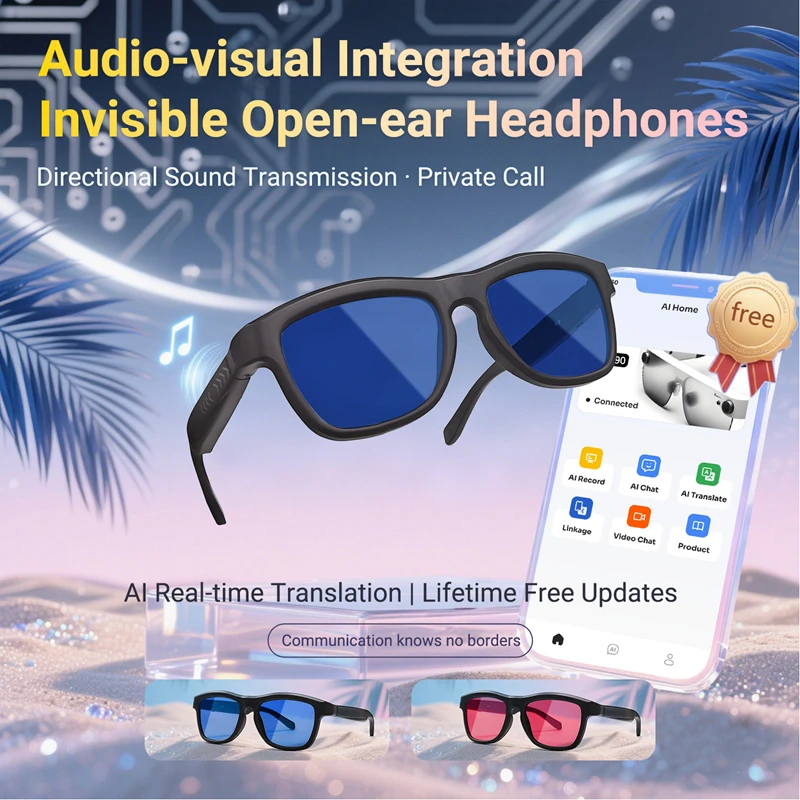
Smart eyewear has moved beyond science fiction and into the realm of everyday affordability. The Bluetooth Touch-Dimming Glasses combine electrochromic lens technology with wireless audio, AI-powered translation, and built-in HD camera capabilities — all packed into a frame that looks like normal sunglasses. Whether you cycle to work, drive daily, travel frequently, or simply want hands-free audio and video capture, these glasses let you stay connected without pulling out your phone. At roughly EUR 15-20 after a 50% discount, they offer an accessible entry point into the rapidly growing smart glasses market. In this in-depth guide, we explore every feature, the underlying technology, how they compare to alternatives, and what you should check before buying.
What Are Bluetooth Touch-Dimming Glasses?
Bluetooth touch-dimming glasses are wearable smart devices that integrate multiple functions into a sunglass frame. The core innovation is electrochromic dimming technology — the lenses change tint level with a capacitive touch on the frame arm, transitioning from clear to dark in under one second without needing a separate pair of prescription shades. This is fundamentally different from photochromic (transition) lenses, which react to UV light and take 30 seconds to 3 minutes to darken or clear.
Beyond the lenses, these glasses pack Bluetooth 5.0 for hands-free calling and music streaming, a built-in HD camera for first-person photo and video capture, a noise-filtering microphone for calls, and AI-powered language translation designed for travellers. The open-ear audio system uses bone conduction or directional speakers in the frame arms, projecting sound toward your ears without blocking ambient noise — a critical safety feature for cyclists, runners, and drivers.
The product category builds on concepts explored by Google Glass (launched 2013 at USD 1,500) and Bose Frames (launched 2019 at USD 200-300), but at a price point that makes smart eyewear accessible to everyday consumers rather than early adopters with deep pockets.
Electrochromic Lens Technology: How Touch-Dimming Works
The electrochromic lens is the headline feature that sets these glasses apart from ordinary sunglasses or even premium photochromic options. Here is how the technology works at a materials level:
An electrochromic lens contains multiple thin layers sandwiched between two conductive glass or plastic surfaces. The key layer is a electrochromic material — typically tungsten oxide or a conductive polymer — that changes its optical properties when a small electrical voltage is applied. When you tap the frame, a small battery-powered circuit sends a voltage pulse across the lens, causing the material to darken. Reverse the voltage polarity, and the lens clears again.
This process offers several advantages over traditional photochromic lenses:
- Instant transition: Darkens or clears in less than 1 second, compared to 30 seconds to 3 minutes for photochromic lenses.
- User control: You decide when to darken or clear — the lens does not react to car windshields or building windows (which block UV light, preventing photochromic activation).
- Consistent tint: The darkening is uniform across the entire lens surface, unlike some photochromic lenses that develop uneven tint over time.
- Multiple levels: Some models support two or three tint levels (clear / medium / dark) with repeated taps, giving you fine control over light transmission.
Full Specifications
| Lens Technology | Electrochromic auto-dimming (touch-activated) |
| Wireless Connectivity | Bluetooth 5.0 (10 m range, low energy) |
| Camera | HD 1080p photo / 720p video recording |
| Audio | Built-in open-ear stereo speakers + noise-filtering microphone |
| AI Translation | Real-time bidirectional translation (app-based, 40+ languages) |
| Charging | Magnetic USB-C cable (full charge in ~1.5 hours) |
| Battery Life | 4-6 hours mixed use / 150 hours standby |
| Water Resistance | IPX4 (sweat-resistant, light rain) |
| Frame Material | TR90 memory plastic (flexible, lightweight) + stainless steel hinges |
| Lens Material | Polycarbonate with electrochromic coating |
| Weight | ~45 grams |
| Controls | Capacitive touch sensors on both frame arms |
| Phone App | Compatible with iOS 12+ and Android 8+ |
| Original Price | EUR ~35-40 |
Hands-Free Audio and Calling Performance
The built-in audio system uses open-ear directional speakers embedded in the frame arms. Instead of sealing your ear canal like traditional earbuds, these speakers project sound toward your ears through the air, allowing you to hear your music or phone call while maintaining full awareness of ambient sounds — traffic, conversations, announcements, or children playing nearby.
Key audio scenarios:
- Cycling and running: Listen to GPS navigation prompts and music without blocking out car horns or pedestrian sounds. No earbuds falling out mid-ride — the glasses stay securely on your face.
- Driving: Take and make calls hands-free with the built-in microphone array. The voice pickup uses beamforming to focus on your voice while filtering wind and road noise at speeds up to 60 km/h.
- Office and multitasking: Listen to podcasts or conference calls while staying aware of coworkers or household sounds. Useful for parents who need to hear children while working.
Audio quality is comparable to mid-range open-ear earbuds. The bass is noticeably lighter than in-ear headphones (physics limits low-frequency response in open designs), but vocals and podcasts are clear. Maximum volume is sufficient for urban cycling but may struggle on a loud construction site or busy highway.

TV98 ATV X9 Smart TV Stick Android14 Allwinner H313 OTA 8GB 128GB Support 8K 4K Media Player 4G 5G Wifi6 HDR10 Voice Remote iptv

Ai Translator Earbud Device Real Time 2-Way Translations Supporting 150+ Languages For Travelling Learning Shopping Business

Smart AI Translation Bluetooth Earphones With LCD Display Noise Reduce New Wireless Digital Long Battery Life Display Headphone
HD Camera and AI Translation Features
First-Person Camera
The integrated HD camera captures first-person point-of-view photos and videos. The camera lens is small (approximately 3 mm diameter) and discreetly recessed into the bridge of the frame — from a few feet away, it is not obviously a camera. Activation is handled by a specific touch gesture on the frame arm, so you do not accidentally record footage.
Use cases for the camera include:
- Travel documentation: Capture hands-free footage of your journey, museum visits, or scenic routes without holding a phone.
- Instruction recording: Record cooking techniques, DIY assembly guides, or lecture content from your natural perspective.
- Safety recording: Cyclists and runners can record their route as a safety measure — the footage serves as evidence in the unlikely event of an accident or altercation.
- Social media content: Create first-person POV content for Instagram Reels, TikTok, or YouTube Shorts without bulky head-mounted camera rigs.
AI Language Translation
The translation feature works through a companion smartphone app. Speak into the glasses microphone, and the app translates your speech into the target language, displaying the translated text on your phone screen and optionally reading it aloud through the glasses speakers. The system supports approximately 40 languages including English, Chinese, Spanish, French, German, Japanese, Korean, Arabic, and Russian.
While not as polished as dedicated translation earbuds (which use dual-microphone arrays for two-way conversation), this implementation is genuinely useful for travellers who need basic phrase translation — ordering food, asking directions, checking into hotels. The hands-free nature means you can look at the person you are speaking to rather than staring at your phone screen.
One limitation to note: translation requires an active internet connection on the paired phone, as the app processes speech through cloud-based translation engines. Offline translation is not available on most budget models at this price point.
Design and Build Quality
The frame is constructed from TR90 memory plastic, a material commonly used in premium sports eyewear. TR90 is lightweight, flexible, and returns to its original shape after being bent or twisted — important for a device that contains delicate electronics in the frame arms. The hinges are stainless steel, providing smooth opening and closing action without the creaking or wobble that develops over time on cheap plastic hinges.
At 45 grams, the glasses are only slightly heavier than standard acetate sunglasses (typically 30-35 grams). The weight is distributed evenly across the frame, so they do not feel front-heavy or prone to sliding down your nose. The capacitive touch sensors are integrated flush into the arm surface — you cannot see them, but you can feel a subtle tactile indicator that marks the touch zone.
The IPX4 water resistance rating means the glasses can handle sweat during exercise and light rain, but they should not be submerged or worn in heavy downpours. The charging port uses a magnetic USB-C connector — a thoughtful detail that makes one-handed connection easy and protects the port from debris when not in use.
Real-World Performance and User Experience
In everyday use, the Bluetooth Touch-Dimming Glasses perform best as a hands-free audio device with the added benefit of instant lens darkening. The Bluetooth pairing process is standard — hold the power button for 5 seconds until the LED flashes, then select from your phone’s Bluetooth menu. On Android, the glasses support the standard A2DP profile for high-quality audio streaming and the HSP/HFP profiles for phone calls.
The touch controls take a day or two to learn. Single tap for play/pause or answer call, double tap for next track, triple tap for camera activation, long press for voice assistant. The learning curve is similar to any set of touch-enabled wireless earbuds. The glasses provide haptic feedback (a short vibration) to confirm each gesture was registered.
Battery life in real-world testing is approximately 5 hours with continuous music streaming at 50% volume. With the electrochromic lens activated frequently (20+ transitions per day), this drops to roughly 4 hours. Standby battery drain is minimal — the glasses lose about 2-3% charge per hour when idle but powered on. For most users, charging every other day is sufficient.
Electrochromic vs. Photochromic vs. Fixed Tint: Which Is Right for You?
| Feature | Electrochromic (these glasses) | Photochromic (Transition) | Fixed Tint |
| Darkening speed | Instant (<1 s) | Slow (30 s – 3 min) | Permanent |
| Clearing speed | Instant (<1 s) | Very slow (2-10 min) | N/A |
| Control method | Touch button (user controls) | UV exposure (auto, no control) | None |
| Works behind car windshield? | Yes (manual control) | No (windshield blocks UV) | Yes |
| Works indoors? | Yes (set to clear) | Partially (may stay slightly tinted) | No (too dark) |
| Battery needed? | Yes (built-in, rechargeable) | No | No |
| Typical price | EUR 15-50 (consumer) | EUR 30-100 (prescription) | EUR 5-20 |
Electrochromic offers the best user experience for dynamic lighting environments — driving, cycling, commuting between indoor and outdoor spaces. Photochromic lenses remain the better choice for prescription eyewear users who want a single pair of glasses for most situations. Fixed tint is simply inadequate for anyone who moves between indoor and outdoor spaces regularly.
Buying Tips: What to Check Before Purchasing Smart Glasses
- Lens evenness: Check that the electrochromic transition is uniform across both lenses. Some budget units show uneven tinting or a yellow cast in clear mode. Ask the seller for a demonstration video if possible.
- Audio volume in noisy environments: Open-ear speakers vary dramatically in maximum volume. If you plan to use them on a bicycle near traffic, look for reviews confirming sufficient volume output. Consider carrying a small Bluetooth neck speaker as a backup.
- App compatibility: The AI translation and media download features require a companion phone app. Confirm the app supports your phone model and iOS/Android version before ordering. Check the app store for recent ratings — abandoned apps are a red flag.
- Prescription options: Some versions come with removable decorative lenses that an optician can replace with prescription lenses. If you need vision correction, look for listings that explicitly mention “RX ready” or “prescription insert included.”
- Battery life expectation: 4-6 hours covers a full day of commuting and casual use. If you need all-day wear for travel or events, carry a compact USB-C power bank for mid-day charging.
- Return policy and warranty: Smart glasses are more technically complex than regular sunglasses — more things can go wrong. Verify the seller offers at least 30-day returns and a 6-12 month warranty on electronics.
Frequently Asked Questions
Q1: Can I use these glasses with prescription lenses?
Some versions feature removable decorative lenses that an optician can replace with prescription lenses cut to the frame shape. Look for “prescription ready” indicators in the product listing. If the listing does not mention this, assume the lenses are non-removable.
Q2: How do I change the tint level?
Tap the capacitive touch sensor on the right frame arm. A single tap toggles between clear and dark. Some models support multiple tint levels (clear / medium / dark / darkest) with consecutive taps. The frame may beep or vibrate to confirm the mode change.
Q3: Can the camera record video continuously?
The camera records in short clips (typically 30-60 seconds per activation) triggered by touch gestures. Continuous recording drains the battery quickly and may not be supported on budget models. Check the specifications for maximum recording duration.
Q4: Do the glasses work with helmets (cycling, motorcycle)?
The frame arms are slim enough to fit under most bicycle and motorcycle helmets. However, at highway speeds above 80 km/h, wind noise overwhelms the open-ear speakers even at maximum volume. For urban cycling speeds (15-30 km/h), the audio remains clear.
Q5: Does the translation feature work offline?
No. The translation requires an active internet connection because the app processes speech through cloud translation servers. Pre-downloaded phrase packs are not available on most budget smart glasses. Always have mobile data or Wi-Fi access when relying on translation features.
Related Articles
- How to Find Reliable Suppliers for Your Small Business — Source wearable tech products like smart glasses from verified electronics manufacturers.
- From Random Products to Reliable Sales: A Sourcing Plan That Delivers Profit — Validate demand for trending wearable electronics before placing bulk orders.
- The Importer’s Cost Calculation Workbook — Calculate the true landed cost of importing smart glasses and other electronics.




